- Ph.D., University of Chicago, 1997

Kate Abramson
Mahlon Powell Professor, Philosophy
Director of Undergraduate Studies
Mahlon Powell Professor, Philosophy
Director of Undergraduate Studies
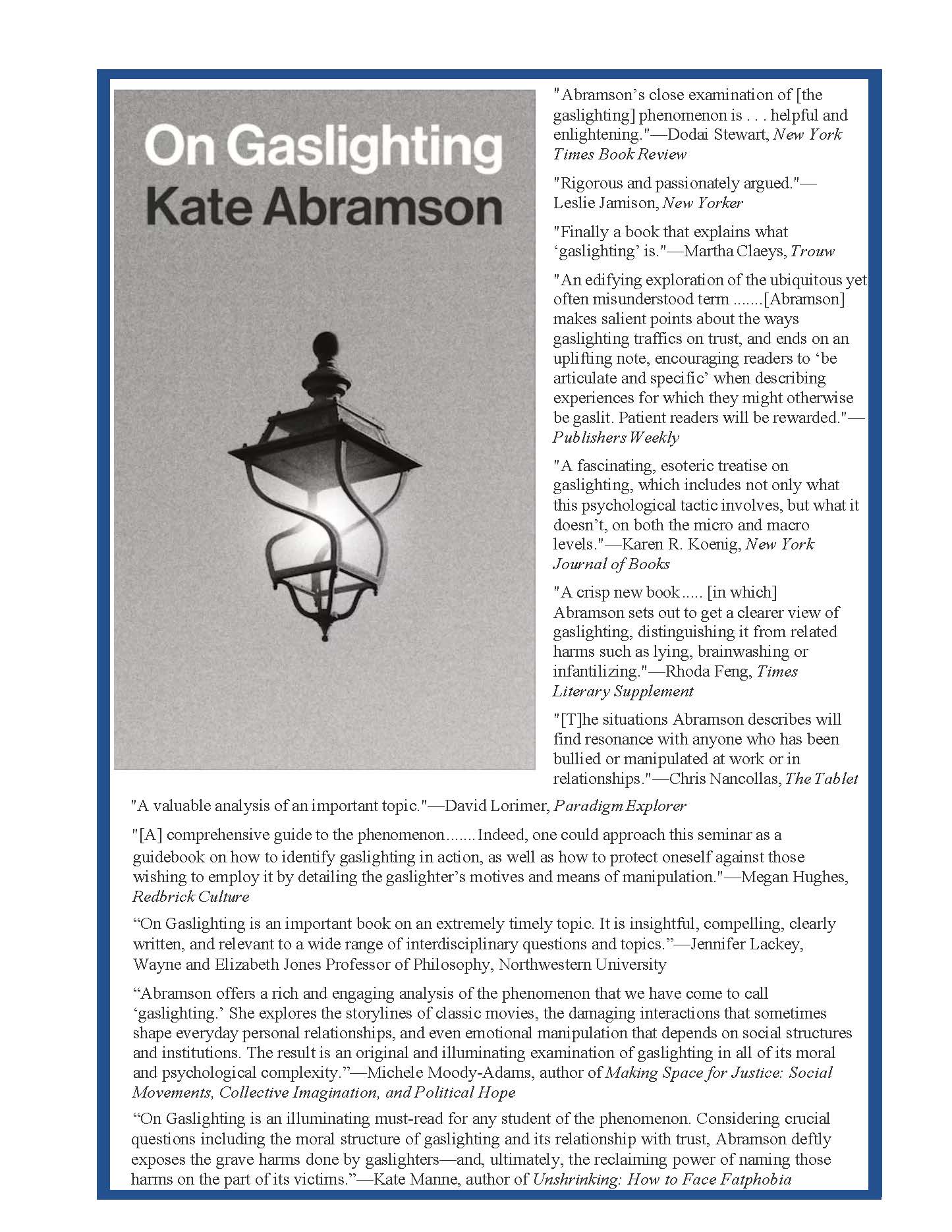
I am Mahlon-Powell Professor in the Department of Philosophy and Director of Undergraduate Studies. I also serve on the governing board of IU Bloomington’s Philosophy, Political Science and Economics program (PPE), and on the oversight committee for the “Common Ground Initiative” run by the Office of the Vice Provost. I served for three years as an elected member of the policy committee for the College of Arts and Sciences at IU-Bloomington (CPC). I have been a fellow at Princeton University’s Center for Human Values and awarded grants by the American Council of Learned Societies, the American Philosophical Society, the Newberry Library and the AAUW (the latter two I had to decline, having accepted other grants). I’ve been interviewed about my work for numerous public-facing venues including the NPR program “Think” and The Guardian, and my recent monograph On Gaslighting (2024) has been the subject of substantial crossover attention including extended reviews in the New York Times and New Yorker. On Gaslighting has also now been translated into Dutch, Turkish, (simplified) Chinese, Greek, Spanish and Portuguese, and been issued in a separate special Australian edition.
Current Research:
My research explores an array of intersecting issues in ethics (especially moral psychology and character), Early Modern Philosophy (particularly Hume), and social/political philosophy (including philosophical feminism). My work also commonly involves forays into matters of philosophical psychology that extend beyond anything that is specifically ethical, as well as issues at the intersection of epistemology and ethics.
These areas are intertwined with one another in different ways in my current research projects.
Gaslighting: My first article on gaslighting was the first article in philosophy on the topic. At the time, even the term was only rarely used colloquially. By the time I published On Gaslighting in 2024, all that had changed. As the jacket blurb says:
“Gaslighting” is suddenly in everyone’s vocabulary. It’s written about, talked about, tweeted about, even sung about (in “Gaslighting” by The Chicks). It’s become shorthand for being manipulated by someone … who isn’t just lying … but trying to drive you crazy. […] Kate Abramson examines gaslighting from a philosophical perspective, investigating it as a distinctive moral phenomenon. Gaslighting, Abramson writes, is best understood as a form of interpersonal interaction, a particular way of fundamentally undermining someone. The gaslighter, Abramson argues, aims to make his target experience herself as incapable of reasoning, perceiving, or reacting in ways that would allow her to form appropriate beliefs, perceptions, or emotions in the first place. He seeks not only to induce in her this
unmoored sense of herself but also to make it a reality. Using examples and analysis, Abramson gives an account of gaslighting and its immorality, and argues that such a discussion can help us understand other aspects of social life—from racism and sexism to the structure of interpersonal trust.
My work on gaslighting continues, with new work particularly focused on elucidating the relationship between gaslighting and other nearby phenomena, and the insights we can gain about other major issues in ethics from reflecting on gaslighting (in the way the monograph argues that thinking about gaslighting illuminates the structure of interpersonal trust).
Questions of character: I’m in the initial stages of writing a book titled Character is a matter between us in which I seek to offer a new account of character that can help us sort through and make sense of everyday ethical practices in this arena. My alternative to well-known Kantian and neo-Aristotelian theories of virtue is inspired by Hume, but draws substantially different lessons from the historical Hume than do contemporary ‘Humean’ ethicists. One dimension of this new account appears in my “Character as a Mode of Evaluation” (2016). There is a long philosophical tradition that continues to guide contemporary ethics in which character attributions (e.g. generous, malicious) are thought to pick out fundamentally different kinds of attributes than, say, psychological abilities/disabilities or aspects of mental health and illness. Some have even gone so far as to argue that the distinctions at issue here are distinctions in natural kinds. I argue that this is fundamentally misguided. Instead, we ought to view character attributions as belonging to a distinctive moral mode of evaluation, one that is equally informed by both facts about the agent and her psychology, and in situ interpersonal considerations. One benefit of this view is that it allows us make sense of the fact we sometimes treat it as appropriate to regard a person under a medical mode of evaluation (say, as “depressed”) and at other times regard her under the moral mode of character (say as “mean”) even though the very same aspects of the agent’s psychology are invoked in both cases.
Love and Empathy: I have published several papers with Adam Leite on issues relating to love, self-love, reasons, and valuing. We have plans for an eventual book on these issues. Our article “Love as a Reactive Emotion” was awarded the 2010 Philosophical Quarterly Essay Prize. We have also co-authored a related paper on empathy and emotional attunement which analyzes a form of empathy not discussed in the otherwise vast literature on the subject, and which demonstrates the usefulness of reflecting on that form of empathy for questions as disparate as issues in psychoanalysis and issues in political philosophy.
Reactive Attitudes: My work with Adam Leite on love and empathy is one aspect of a broader research interest I have in the reactive attitudes, especially those reactive attitudes that are character-focused rather than action-focused. I’ve published work in this territory on contempt, shame and disdain (e.g. “A Sentimentalist’s Account” 2010) and explore related structural issues about the connection between our affective dispositions and character traits in “Affective Conflict and Virtue” (2013).
Hume’s Ethics and its evolution: I am in the final stretches of completing a book (in development with Oxford University Press) on the evolution of Hume’s moral theory, The Artifice of Nature. Scholars have long adopted one of two views about the relationship between Hume’s early work in ethics in the Treatise and his later work in Enquiries and Essays. Some claim that the development at issue here is merely one of writing style—the later works are abbreviated, more
accessible, versions of the views laid out in the Treatise. Others claim that the doctrine of Hume’s moral philosophy radically shifted between his early and his later works. I contend that both these views are significantly misguided. What changed for Hume was nothing less than his views about the project of writing moral philosophy—it’s appropriate aims, methods, audience, focus and writing style. Failure to pay attention to this dimension of Hume’s work has led scholars to then misinterpret the doctrine of Hume’s ethics. One example of this is Hume’s discussion of the sensible knave in the second Enquiry. In a pair of new pieces, I argue that scholars have to date universally misunderstood not only Hume’s answer to the sensible knave, but also who is the knave, what is her character, and what precisely is the question she poses.
Abramson, Kate. 2026. “The Forensic Notion of the Self and the Sensible Knave” in British Philosophy in the Long Eighteenth Century: Themes from Kenneth Winkler, edited by B. Ehli and M. Lesinger, Routledge.
Abramson, Kate & Leite, Adam. 2024. “Love, Value, and Reasons," in The Oxford Handbook of the Philosophy of Love, edited by C. Grau and A. Smuts, Oxford University Press: 99-117.
Abramson, Kate & Leite, Adam. 2021. “Self-Love and Self-Acceptance” in The Philosophy and Psychology of Ambivalence, edited by B .Brogaard & D. Gatzia, Routledge: 147-174.
Abramson, Kate & Leite, Adam. 2019. “Empathy without Sharing: Empathetic Responsiveness in Psychoanalysis and Politics” Philosophical Perspectives on Empathy, edited by in D. Matravers and A. Waldow, Routledge: 144-166.
Abramson, Kate. 2016. “Character as a Mode of Evaluation”, Oxford Studies in Normative Ethics v. 6., edited by M. Timmons, Oxford University Press: 56-76.
Abramson, Kate. 2015. “What’s so ‘Natural’ about Hume’s Natural Virtues?” in The Cambridge Critical Guide to Hume’s Treatise, edited by Donald Ainslie & Anne Marie Butler, Cambridge University Press: 333-368.
Abramson, Kate. 2013. “Affective Conflict and virtue: Hume’s answer to Aristotle,” The Reception of Aristotle’s Ethics, edited by Jon Millar, Cambridge University Press: 222-243.
Abramson, Kate & Leite, Adam. 2011. “Love as a Reactive Attitude”, Philosophical Quarterly v.61.n245: 673-699. Winner of the annual Philosophical Quarterly international essay prize competition.
 The College of Arts